Cabinet Knob Size Guide 2026: How to Choose
This 2026 cabinet knob size guide covers diameter, projection, placement, and screw length — so you get the right size before you drill a single hole.
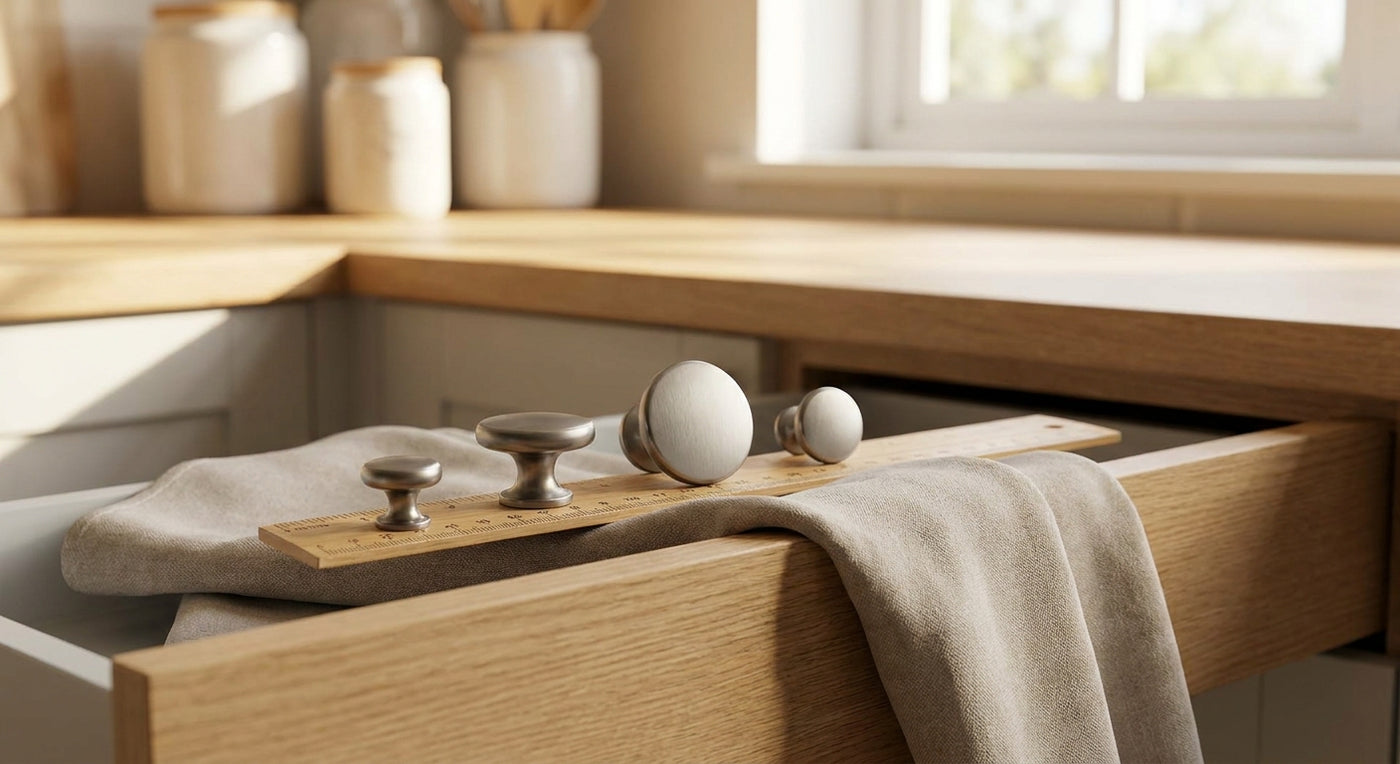
Getting cabinet knob sizing wrong is one of the most common—and expensive—mistakes in a kitchen or bath renovation. The right size reads as intentional; the wrong size looks like an afterthought.
TL;DR: This cabinet knob size guide covers the four decisions that actually matter in 2026: knob diameter, projection off the door face, center-to-center drilling, and scale relative to cabinet size. For standard upper cabinet doors, a 1–1/4" to 1–3/8" diameter knob is the default starting point. Larger drawers and statement pieces call for 1–1/2" or bigger. Get any of these four decisions wrong and even a $40 knob looks cheap.
Why Sizing Matters More Than Style
A knob that is too small on a wide drawer front disappears visually and requires a grip that strains fingers after the third cup of coffee. A knob that is too large on a narrow shaker door looks cartoonish and can hit adjacent doors or the frame when opened. Scale is proportionality, and proportionality is the difference between a hardware upgrade that photographs well and one that earns a compliment in person every time someone visits in 2026.
Knobs.co carries over 50,000 SKUs across major brands, which means the choice is never a shortage problem—it is a calibration problem. This guide gives you the calibration.
What You'll Need
- Tape measure or digital calipers
- Door and drawer dimensions (width and height in inches)
- Existing drill hole diameter if replacing hardware (standard is 8-32 machine screw, hole diameter 5/32" to 3/16")
- Note of existing center-to-center spacing if mixing knobs with pulls on the same project
- 15–20 minutes per cabinet run to measure before ordering
The Steps
Step 1: Measure Your Door and Drawer Faces
Measure the width and height of every cabinet door and drawer front you are fitting. Write them down. Do not estimate.
Why it matters: Knob diameter is chosen relative to door face width. A door that is 12" wide uses a different scale knob than a door that is 18" wide, even though both are "upper cabinet doors." Getting exact dimensions keeps you from ordering a sample that looks right in isolation but wrong once installed.
Expected outcome: A simple list—upper doors 14" wide, lower doors 18" wide, drawers 24" wide—that drives every size decision below.
Common mistake: Measuring only one door and assuming all are the same. Cabinet runs often include doors of 2–3 different widths.
Step 2: Match Knob Diameter to Door Width
The industry starting rule in 2026 is straightforward:
- Doors up to 15" wide: 1" to 1–1/4" diameter
- Doors 15"–24" wide: 1–1/4" to 1–3/8" diameter
- Doors over 24" and large drawer fronts: 1–1/2" and above
A 1–1/8" knob such as the Amber Crystal Knob 1-1/8 in brushed satin nickel works on most upper cabinet doors in standard 42" kitchen upper runs. Step up to the Amber Crystal Knob 1-3/8 for wider doors or drawers where the slightly larger face reads better at 3–4 feet.
Why it matters: Diameter controls visual weight. The rule above is a default—style, finish, and profile shape can all justify going one step larger or smaller—but it gives you an anchored starting point before visual judgment takes over.
Expected outcome: You have a target diameter range for each door and drawer category in your project.
Common mistake: Choosing a knob based on catalog photos taken against a blank white background. Always request a physical sample or compare the diameter dimension in the product specs against your measured door width.
Step 3: Confirm Projection (Depth Off the Door Face)
Projection is how far the knob sticks out from the door surface. Standard knob projection runs from about 3/4" to 1–1/2". High-projection knobs (over 1") are easier to grip but can catch on clothing in tight galley kitchens. Low-projection knobs suit modern flat-front cabinets where visual flush-ness matters.
Why it matters: Projection affects ergonomics in daily use. In a kitchen with 36" aisles—the minimum code clearance—a knob projecting 1–1/2" on every lower door reduces effective clearance to roughly 35". Not a problem for one person; noticeable when two people work simultaneously.
Expected outcome: A projection spec that matches your kitchen layout and the grip style of the people using the space most.
Common mistake: Ignoring projection entirely and discovering that a dramatic architectural knob hits a neighboring door frame every time the cabinet opens.
Step 4: Set the Placement on the Door
Standard placement rules for 2026:
- Upper cabinet doors (hinged left or right): Place knob 2"–3" from the bottom corner on the latch side, centered on the rail.
- Lower cabinet doors: Place knob 2"–3" from the top corner on the latch side.
- Drawers: Center the knob horizontally on the drawer face, centered vertically or at the top third for deep drawers.
Why it matters: Consistent placement across a run makes an inexpensive knob look intentional. Inconsistent placement makes an expensive knob look amateur.
Expected outcome: A marked template (a piece of cardboard with a pilot hole works fine) that you hold against each door to confirm position before drilling.
Common mistake: Measuring from the edge of the door instead of the edge of the face frame reveal, which shifts knobs on framed cabinets an extra 1/2"–3/4" inward.
Step 5: Verify the Screw Length Against Door Thickness
Most knobs ship with a 1" machine screw. Standard face-frame door thickness runs 3/4". Full-overlay frameless doors run 5/8"–3/4". The screw must pass through the door and thread fully into the knob post—at least 3 full threads.
Why it matters: A screw that is 1/8" too short will strip out and spin in place. A screw that is 3/8" too long will bottom out in the post and leave the knob loose.
Expected outcome: A confirmed screw length for each door thickness category. Order 1–1/4" screws for doors over 3/4" and 3/4" screws for thin slab doors under 5/8".
Common mistake: Using the included screw without measuring first, then discovering the problem only after drilling 20 holes.
Step 6: Order a Sample Before Committing to a Full Run
On any order covering more than 10 cabinets, order a single knob first, install it on one door with the exact screw length you confirmed in Step 5, and live with it for 24 hours. Look at it in morning light, evening light, and under cabinet task lighting.
Why it matters: Finish photography and screen calibration vary. A "brushed satin nickel" knob on one manufacturer's product page looks cool-toned; the same description from a different brand looks warm. The Serene Kara Knob 1" and a generic hardware store brushed nickel knob may share a name but not a finish.
Expected outcome: Confirmation or rejection of finish and scale before bulk spend.
Common mistake: Ordering a full cabinet run based on one product image, then discovering that the finish reads silver under LED lighting when the rest of the kitchen runs warm.
Troubleshooting
Knob spins freely after installation: Screw is too short and not threading into the post. Replace with a longer screw—add 1/4" and recheck.
Knob sits at an angle instead of flush: Door surface is not flat (bowing or warp) or screw hole was drilled off-perpendicular. Use a drill guide for consistent 90-degree drilling.
Diameter looks right on one door but too small on the drawer: You used a single size for all hardware. Drawers almost always call for one step up in diameter or a switch to a pull for faces wider than 18".
Screw tip visible inside cabinet: Screw is too long. Switch to a shorter length or install a screw cover cap available from the same brand family.
Tools and Resources
- Digital calipers (more accurate than a tape for sub-1/4" measurements)
- Cardboard drilling template cut to your door width
- 5/32" drill bit for standard 8-32 machine screws
- Knobs.co product pages for precise diameter, projection, and screw size specs—every listing includes dimensional data
- For wider drawer fronts and appliance panels, the Morris Florham Appliance Pull 18-inch demonstrates how larger hardware is specified for proportional scale on refrigerator and dishwasher panels
What to Do Next
Once diameter and placement are confirmed, the next decision is finish coordination across knobs, pulls, and hinges in the same space. The guide on how to mix brushed nickel hardware across rooms covers the rules for mixing hardware finishes without creating visual chaos.
FAQ
What size cabinet knob is most common? The 1–1/4" diameter is the most widely specified size in 2026 for standard upper cabinet doors 14"–18" wide. It grips naturally, reads clearly at 10 feet, and clears most face frame reveals without collision.
Is a 1" knob too small for kitchen cabinets? For upper doors under 14" wide, 1" works. On anything wider, it reads as undersized—especially on shaker-style doors where the flat rail surface emphasizes scale. Step up to 1–1/4" for most kitchen applications.
How far from the corner should I place a cabinet knob? For both upper and lower doors, place the center of the knob 2"–3" from the nearest corner on the latch side. Split the difference at 2–1/2" on doors with rails narrower than 2" to avoid placing the hole in the joint.
Can I use the same knob size on drawers and doors? On narrow drawers (under 18" wide), yes. On wide drawers (18" and above), move up one diameter size or switch to a bar pull. A knob on a 30" drawer front looks underpowered and requires an awkward grip.
What screw length do I need for most cabinet knobs? A 1" screw covers the majority of 3/4" face-frame doors with standard knob post depth. Measure your door thickness, confirm the knob post depth in the spec sheet, and add 3/16"–1/4" for thread engagement. When in doubt, 1–1/4" screws are the safe fallback.
How do I know if a knob is the right projection for my kitchen? Stand at the cabinet with your hand hanging naturally. Reach for where the knob would be. If you have to cup your hand awkwardly, projection is too low. If the knob snags your wrist, it is too high. Most kitchens land in the 1"–1–1/4" projection range.
Do crystal or ornate knobs follow the same sizing rules? Yes for diameter and placement. No for visual weight: a crystal or highly decorative knob at 1–1/8" reads larger than a simple dome knob at the same diameter because the surface detail catches light. When in doubt, size down by 1/8" from your standard calculation.
Does knob size need to match pull size in the same kitchen? Not exactly, but the visual weight should align. If your pulls read as bold on drawer fronts, choose a knob on the larger end of the appropriate diameter range for doors. A 1–1/4" knob next to a heavy 5" pull looks undersized; a 1–3/8" knob balances it.
One Last Thing
The single number most people forget to check before drilling: the diameter of the existing hole if you are replacing old hardware. Standard is 5/32"–3/16" for an 8-32 screw. Some older European hardware used metric M4 screws (0.157") which is almost identical but not interchangeable. If you are reusing holes, pull one existing screw and confirm the thread spec with a thread gauge or by matching it at a hardware store before ordering 40 new knobs.