Polished Nickel Pulls for Bathroom Vanities (2026 Guide)
Choosing polished nickel pulls for a bathroom vanity in 2026? Get sizing rules, durability facts, and three specific Atlas Homewares picks with honest verdicts.
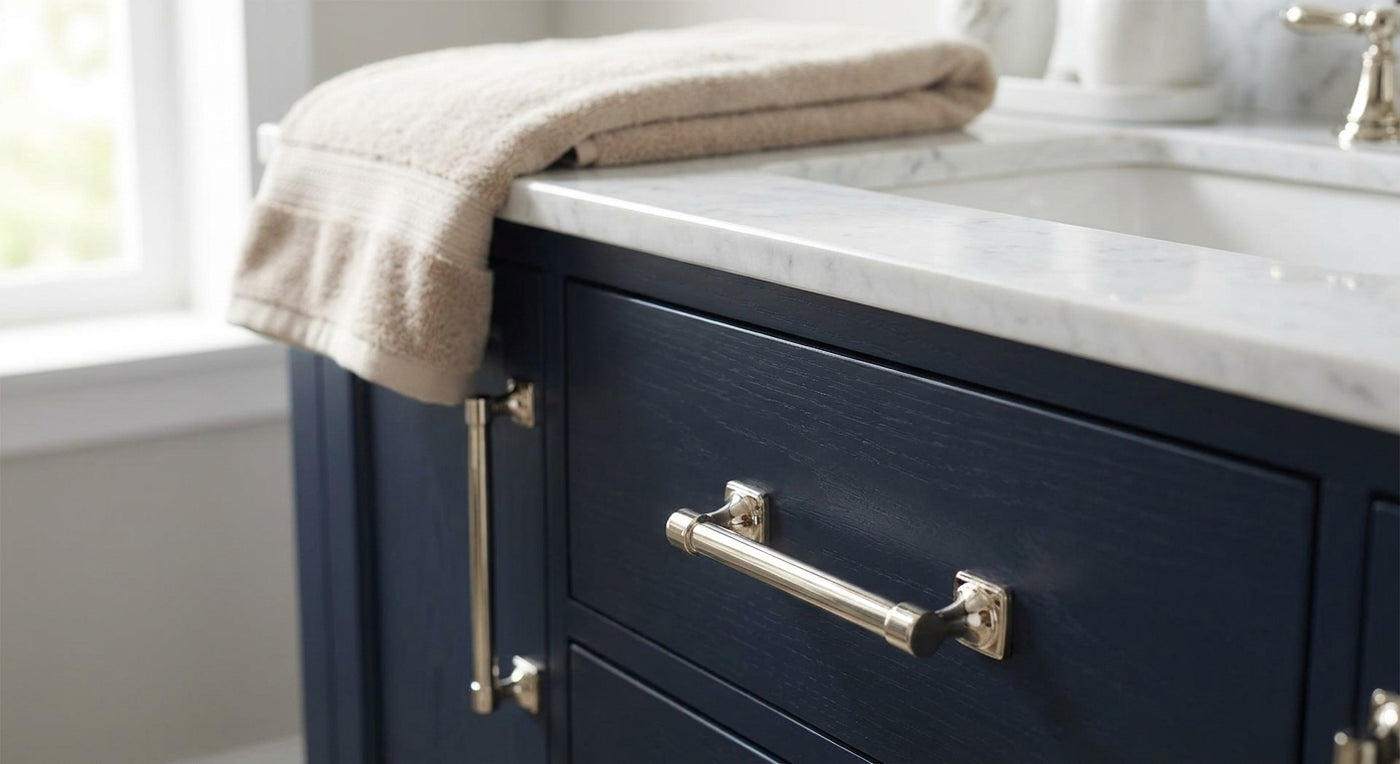
Polished nickel pulls bring a mirror-bright finish to bathroom vanities that neither brushed nickel nor chrome can match — here is exactly who should buy them, what to look for, and which Atlas Homewares options to consider in 2026.
TL;DR: Polished nickel pulls bathroom vanity buyers are typically after warmth without yellow, and shine without the cold edge of chrome. For a single-door vanity, a 3-inch bar pull hits the sweet spot. For wider drawers, go 5 inches or longer. The Austen Oval Pull in polished nickel is the safest all-around pick for traditional and transitional bathrooms in 2026. If your vanity has flat-front doors, the Alcott Pull at 5-inch center-to-center gives you cleaner geometry.
Why Polished Nickel Works on Bathroom Vanities
Polished nickel sits between chrome and unlacquered brass on the finish spectrum. It reads as cool-silver in bright light and picks up a subtle warmth in dimmer bathroom lighting. That dual character makes it forgiving across tile colors — white subway, gray marble, and sage green all co-exist with it without conflict. Chrome is cooler and harder; brushed nickel is quieter and more muted. Polished nickel gives you reflection without the blue tint that chrome carries. In 2026, it is one of the few finishes that pairs credibly with both traditional millwork and contemporary slab-door vanities.
Who This Is For
This guide is for homeowners and design professionals speccing hardware for a bathroom vanity — one, two, or three-bank drawers, plus door pulls. You are replacing outdated hardware or finishing a remodel, and you have already decided on polished nickel as your finish. You want specific size guidance and a short list of credible options, not a 40-product gallery.
What to Look for in Polished Nickel Pulls for a Bathroom Vanity
Center-to-Center Sizing
Pull sizing is defined by center-to-center (cc) measurement — the distance between the two screw holes. Standard vanity drawers in 2026 take a 3-inch or 5-inch cc pull. Door pulls run 3 inches to 8 inches depending on door width. Measure your existing hole spacing before ordering; incorrect sizing means drilling new holes, which shows on painted vanities. If you are starting from scratch, 3 inches cc is the default for doors and small drawers; 5 inches cc for drawers wider than 15 inches.
Finish Durability in a Humid Environment
Polished nickel is a plated finish over brass or zinc. In a wet, steam-prone bathroom, cheaper plating delgams within 18 to 24 months. Look for solid-brass substrate and multi-step plating. Atlas Homewares products use solid brass or zinc alloy cores with protective lacquer over the nickel. That matters more in a bathroom than in a kitchen because daily humidity cycles are constant.
Profile and Projection
How far a pull projects from the face of the cabinet determines grip comfort and clearance from the drawer box. Most bar pulls project 1 to 1.5 inches. Cup pulls and oval pulls project less — useful on a narrow vanity where a bar pull would catch towels or robes. Oval pulls like the Austen sit close to the door face; bar pulls give a firmer grip on heavy drawer stacks.
Backplate Compatibility
If your vanity doors are inset rather than overlay, a backplate hides the routed pocket or drill marks. Not every pull ships with a backplate option, and not every backplate is available in polished nickel. Confirm before ordering. Knobs.co stocks Atlas Homewares backplate options; cross-reference SKU finishes.
Scale to Vanity Width
A 3-inch pull on a 48-inch double vanity reads as hardware chosen by accident. Scale matters: single vanities (24 to 36 inches wide) — 3-inch cc pulls on doors, 3 to 5 inches on drawers. Double vanities (48 to 72 inches wide) — 5-inch cc minimum on drawers, 3 to 5 inches on doors. Vanities with a single large drawer bank can carry a 5-inch or 8-inch pull without looking overwrought.
Material and Weight
Solid brass pulls weigh more and feel more substantial in hand — important on a vanity that gets opened dozens of times per day. Zinc alloy is lighter and less expensive but acceptable for lighter-duty cabinet doors. For drawer pulls that get daily pull force, solid brass is the better long-term call.
Top Picks for 2026
The Safe Pick — Austen Oval Pull, 5-inch, Polished Nickel
The Austen Oval Pull in polished nickel is a 5-inch cc oval bar pull that reads as traditional without being fussy. The oval profile projects less than a standard cylindrical bar, which helps on narrow vanities. It suits white-painted Shaker vanities, furniture-style vanities, and transitional bathrooms with mixed tile. Verdict: Buy. This is the starting point for most polished nickel vanity projects in 2026.
The Clean-Line Pick — Alcott Pull, 5-inch, Polished Nickel
The Alcott Pull in polished nickel is a 5-inch cc pull with cleaner, more linear geometry than the Austen. Flat-front and slab-door vanities benefit from its simpler profile. If your bathroom leans contemporary or minimalist, the Alcott reads better than an oval or rope-detail pull. Verdict: Buy for modern or transitional vanities with minimal ornamentation.
The Wildcard — Dickinson Pull, 5-inch, Polished Nickel
The Dickinson Pull in polished nickel has a slightly more sculptural form — a gently tapered body that adds visual weight without bulk. It works on furniture-style vanities with legs, on painted MDF doors, and in bathrooms where you want the hardware to register as a design element rather than blend in. Verdict: Consider if your vanity has decorative detail or molding that warrants hardware with its own character.
What to Avoid
-
Buying chrome labeled as polished nickel. The two finishes photograph similarly online. Chrome has a cooler, bluer tone; polished nickel reads warmer. Request a sample from Knobs.co before committing to a full vanity order. The free sample program exists for exactly this reason.
-
Undersizing on wide vanities. A 3-inch pull on a 60-inch double vanity door looks like a mistake. Scale to the door or drawer face — wider surfaces need longer center-to-center measurements.
-
Mixing polished nickel pulls with brushed nickel towel bars. The two finishes look wrong next to each other in the same space. If you are using polished nickel pulls, your towel rings, robe hooks, and toilet paper holder should also be polished nickel. Atlas Homewares offers bathroom accessory collections in polished nickel that match their cabinet hardware finishes — plan the whole room together.
Comparison Table
| Pull | CC Size | Profile | Best Vanity Type | Verdict |
|---|---|---|---|---|
| Austen Oval | 5" | Oval, low projection | Traditional, transitional | Buy |
| Alcott | 5" | Linear, clean | Contemporary, flat-front | Buy |
| Dickinson | 5" | Sculptural, tapered | Furniture-style, detailed | Consider |
FAQ
What size pull should I use on a bathroom vanity door? For a standard vanity door in 2026, a 3-inch cc pull works on doors up to about 18 inches wide. For doors wider than 18 inches or for a visual balance on a double vanity, use a 5-inch cc pull.
Is polished nickel better than brushed nickel for a bathroom? Neither is objectively better — they suit different aesthetics. Polished nickel shows fingerprints and water spots more readily but delivers more reflective presence. Brushed nickel hides daily use better. In a formal or traditional bathroom, polished nickel earns its maintenance demands.
Will polished nickel pulls tarnish in a bathroom? Quality polished nickel pulls with lacquer protection resist tarnish for years in normal bathroom conditions. Avoid abrasive cleaners; wipe with a damp cloth. Cheaper plating on non-brass substrates will tarnish or delaminate within 1 to 2 years of daily humidity exposure.
How many pulls do I need for a bathroom vanity? Count one pull per door and one per drawer. A 48-inch double vanity with two doors and three drawers needs 5 pulls total. Order 2 to 3 extras if you have any chance of adding storage or replacing a pull later — finishes can be discontinued.
Can I use polished nickel pulls with gold or brass fixtures in the bathroom? Yes, but intentionally. Polished nickel and polished brass read as a deliberate mixed-metal scheme in 2026 bathrooms. Avoid mixing polished nickel with satin brass or antique brass — the contrast reads as accidental rather than designed.
What finish looks best with white bathroom cabinets? Polished nickel, brushed nickel, matte black, and polished chrome all work with white cabinets. Polished nickel is the warmest of the silver-tone options and tends to give white-painted vanities a more finished, traditional look.
What is the most popular pull size for bathroom vanities in 2026? 5-inch center-to-center pulls are the most-ordered size for drawer pulls on bathroom vanities in 2026. For door pulls on single doors, 3-inch cc remains the standard.
Do I need backplates with polished nickel pulls? Only if your door or drawer front has existing holes that do not align with your new pull, or if you prefer the layered visual effect. Backplates add visual weight and formality — they suit traditional vanities more than contemporary ones.
One Last Thing
Polished nickel is one of a small handful of finishes that can look right with both a pedestal sink in a Victorian-era bathroom and a floating slab-door vanity in a new build. That range is rare. The finish owes its versatility to its warmth at low light levels — at 10 PM with just a vanity sconce on, polished nickel glows in a way that chrome never does. If you are on the fence between the two, that low-light behavior is the deciding factor most designers land on in 2026.