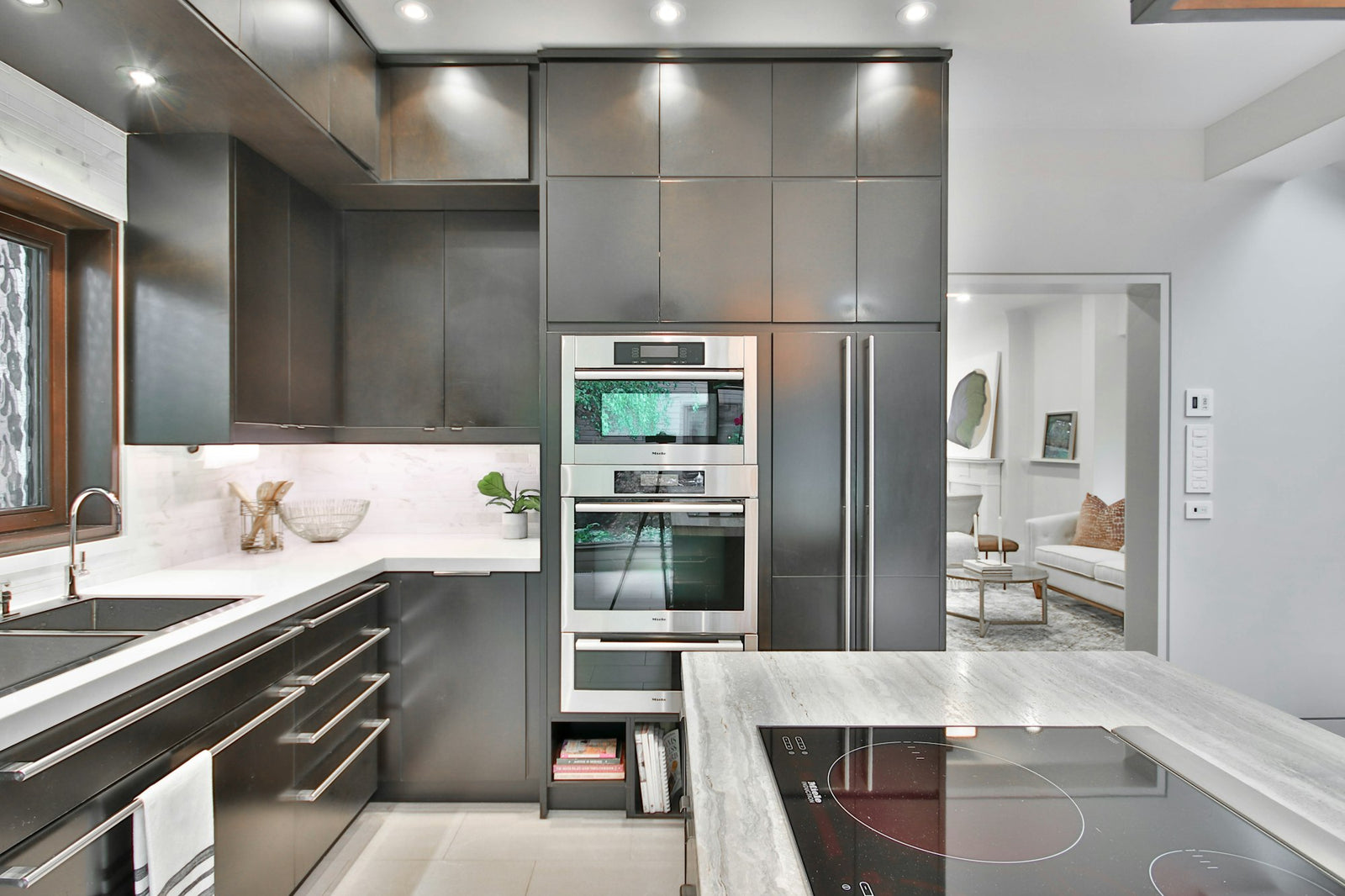
"Can I mix metals?" is the most-asked question in our customer support inbox. The answer designers gave for thirty years was no: pick one finish per room and stay disciplined. The answer designers give now is yes, with rules. Here are the rules.
Rule 1: Two metals, three places, max
The most common failure mode is mixing too many metals at once. Three or four finishes in a single kitchen reads accidental, not curated. Stick to two metals, and use them in three places at most.
For example: brushed brass on cabinet hardware and pendant lights, polished chrome on faucet and pot filler. Two metals, three places. Reads intentional.
Rule 2: Pick a dominant and an accent
Mixed metals should read as one primary metal with a deliberate counterpoint, not two metals splitting the room. The primary metal should account for roughly seventy percent of the visible metal surface area. The accent metal handles the remaining thirty percent and is reserved for one or two specific functions — typically the faucet, the lighting, or the cabinet hardware.
Rule 3: Mix temperature, not tone
The cleanest mixed-metal kitchens combine one warm metal with one cool metal. The contrast is what makes the mix read as intentional. Two warm metals together (brass and bronze) or two cool metals together (chrome and nickel) tend to read like a near-miss — close enough to look unintentional.
Combinations that consistently work:
- Brushed brass + polished chrome
- Honey bronze + brushed nickel
- Matte black + polished brass
- Antique pewter + polished nickel
Rule 4: Group by function
Each metal should claim a function category, not be sprinkled at random. The cleanest rule of thumb: fixtures get one metal, cabinetry gets the other. Faucet, pot filler, instant hot tap = one metal. Cabinet pulls, knobs, hinges = the other metal. The eye reads the room as two consistent layers rather than a metallic patchwork.
Rule 5: The lighting is its own thing
Pendants and chandeliers can take a third metal if — and only if — the third metal is closer to a finish (matte black or aged brass) than to a polished metal. Lighting reads more as decor than as fixture, so it's allowed slightly more latitude. But this is the rule that gets broken most often. If you don't trust your eye yet, keep the lighting to one of your two primary metals.
When to break the rules
Three places.
Old houses with existing fixtures. If you have antique brass door hardware throughout the house and your renovation budget doesn't extend to replacing it all, treat the antique brass as a third historical layer. The rules above govern the new metals you're introducing; the old metals are the room's bones.
Open-plan kitchens that flow into living spaces. The metals you choose in the kitchen will read in the adjacent room, where they may need to coexist with whatever was already there. In an open plan, sometimes a third metal is unavoidable. Pick it deliberately and place it consistently in the second room.
Maximalist designs. If your reference image is a Parisian apartment with brass, copper, and pewter all visible at once, you're following a different ruleset (the eclectic-by-design tradition) and the rules above don't apply. Live your truth.
The shortcut
If all of this feels like too much: pick brushed nickel as your primary and matte black as your accent, applied in the function-grouping pattern above. It's the lowest-risk mixed-metal combination in 2026, ages well, and survives changes in trend. We'd be happy to spec it for you.
0 comments