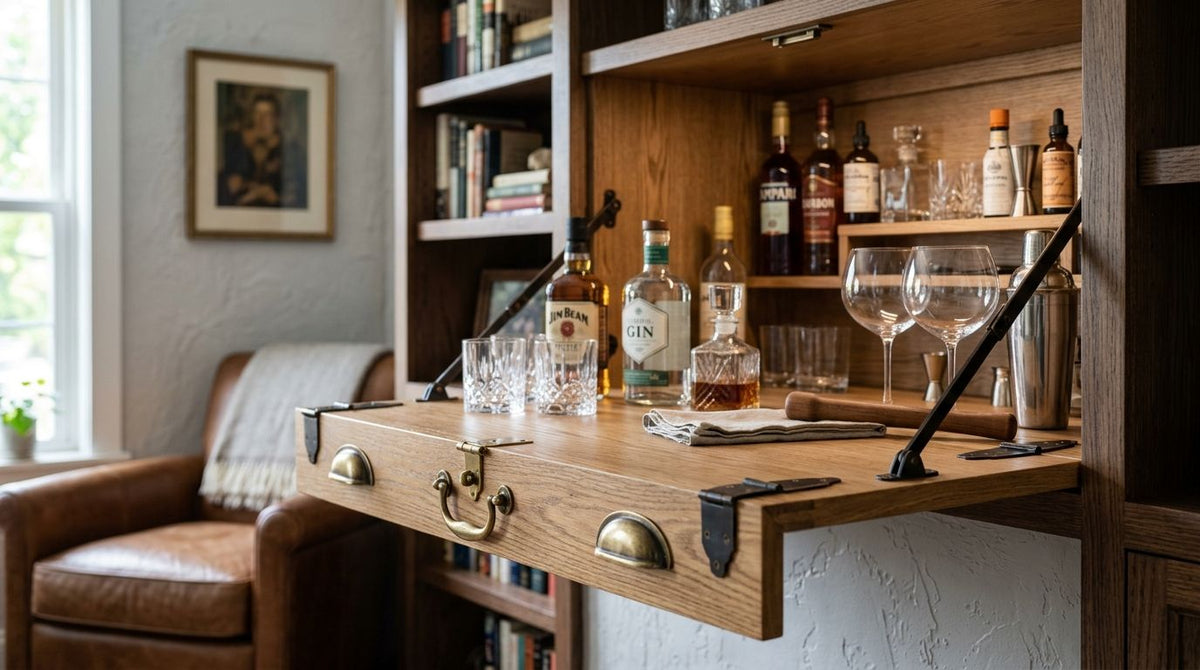
Cabinet hardware for fold-down bar cabinets has to handle repeated flip-down motion, clear the counter edge when the panel swings open, and hold up to spills without corroding — a different job than a stationary kitchen door pull does.
- Cabinet hardware for a fold down bar works best as a bar pull paired with a latch, not a knob alone.
- Bar pulls between 3 3/4 inches and 8 13/16 inches cc cover most fold-down panel widths.
- Soft-close hinges cut slamming on panels folded down several times a day in 2026 remodels.
- Skip decorative knobs on heavy solid-wood panels — they lack the leverage a bar pull gives one-handed.
Why this matters for fold-down bar cabinets
A fold-down bar cabinet panel does double duty as a door and a serving surface, so its hardware takes more repeated stress in a year than a standard kitchen cabinet sees. Every flip down to pour a drink and back up to close it puts load on the hinge, the pull, and any latch — a panel that swings shut on its own or catches a sleeve on a protruding pull turns a nice feature into a nuisance fast.
Homeowners searching for cabinet hardware for a wet bar or home bar cabinet usually hit this problem after the panel is already installed, once they realize the pull picked for the kitchen doesn't work here — too small to grip one-handed while holding a glass, or mounted too close to the counter to clear when the panel drops. Cabinet hardware for fold-down bar cabinets in 2026 needs to solve for grip, clearance, and finish match all at once, not one at a time.
How to choose cabinet hardware for a fold-down bar cabinet
Measure your panel and hinge setup first
Before buying anything, get the exact numbers off the cabinet itself.
- Measure panel thickness with a tape measure — most fold-down bar panels run 3/4 inch, the same as a standard cabinet door
- Note whether the panel hangs on piano hinges, butt hinges, or a drop-down support arm
- Check how far the panel clears the counter overhang once fully open
- Record existing hole spacing (cc) if you're replacing hardware, so new holes line up without filling old ones
Pick a pull profile that clears the counter edge
A bar pull gives more leverage for a one-handed grab than a knob does, which matters when your other hand is holding a glass.
- Bar pulls from 3 3/4 inches to 8 13/16 inches cc handle most panel widths without crowding the edge
- Longer panels, 18 inches or more, can take a 12-inch pull for a full-hand grip
- Lightweight MDF or plywood panels can use a knob instead — Knobs.co's flat top knob in brushed satin nickel works fine on panels that don't need full-bar leverage
- Mount the pull low enough that it clears the counter lip when the panel is horizontal, not just when it's closed
Match the finish to your existing bar or kitchen hardware
A fold-down bar panel sits close enough to the kitchen that mismatched finishes get noticed.
- Brushed satin nickel blends into most existing cabinet hardware without drawing attention
- Flat black or oil-rubbed bronze reads as an intentional accent against lighter cabinetry
- Honey bronze and satin brass pair well with warmer wood tones common in bar builds
- Keep the latch and hinge finish consistent with the pull, not just the pull alone
Add a latch or catch to keep the panel flush when closed
A pull alone won't stop a fold-down panel from creeping open under its own weight.
- A magnetic catch holds light panels flush without visible hardware
- A mechanical latch, like Knobs.co's flat black cabinet latch, gives a firmer hold on heavier panels
- Ball-tip catches are the cheapest fix but wear loose faster on daily-use panels
- Skip friction-only hinges as your only closure — they loosen within a year of daily folding
Reinforce the hinge for repeated folding
The hinge absorbs more cycles here than almost anywhere else in the kitchen.
- Soft-close hinges catch the last few inches of motion instead of letting the panel drop and slam
- Piano hinges spread stress across the full panel width, useful on wider bar doors
- Drop-down support stays (folding arm brackets) take weight off the hinge itself
- Check hinge screws after the first month of daily use — they back out faster on horizontal panels than on vertical doors
Install with a jig for consistent spacing
Consistent hole placement matters more on a panel people touch several times a day.
- A hardware jig holds the drill bit square and repeats identical spacing across multiple pulls
- Mark the panel's center line before drilling so the pull sits level when the panel is open
- Pre-drill a pilot hole to avoid splitting MDF or veneer edges
- Test-fit the screws before final tightening — cc spacing off by even 1/16 inch binds a two-hole pull
Test the swing clearance before finalizing hole locations
Do this after the panel is mounted, not from a paper template alone.
- Fold the panel down fully and check that the pull doesn't hit stemware racks or shelving mounted above
- Open and close the panel 10 to 15 times to confirm the hinge and latch hold under repeated motion
- Check that the pull profile doesn't snag a sleeve when reaching past it to close the panel
- Confirm the finish reads correctly under bar lighting, which tends to run warmer than kitchen lighting
Bar pulls worth checking first
Knobs.co stocks bar pulls, latches, and hinges across a cabinet hardware catalog of more than 50,000 SKUs, so matching an existing kitchen finish to a new bar panel is usually one search, not a redesign.


Comparing your hardware options for a fold-down bar panel
| Option | Best for | Key limitation |
|---|---|---|
| Bar pull (3 3/4"-12" cc) | Daily one-hand use, heavier panels | Longer bars can crowd a low counter overhang |
| Square or round knob | Lightweight MDF or plywood panels | Less leverage than a pull on solid wood |
| Recessed or flush pull | Panels that fold flat with no clearance | Slower to grip when pouring |
| Cabinet latch or catch | Holding the panel flush between uses | Not a substitute for a pull — needs its own handle |
| Soft-close hinge | Panels folded down several times a day | More installation care than a standard butt hinge |
Verdict: a bar pull sized to the panel width, paired with a mechanical latch, wins for daily-use fold-down bar cabinets — knobs and magnetic catches are fine for light, occasional-use panels only.
Common mistakes with fold-down bar cabinet hardware
- Choosing a decorative knob for a heavy solid-wood panel — knobs work on light MDF, but a 3/4-inch solid-wood panel needs a bar pull's leverage or it becomes hard to lift one-handed.
- Skipping a latch entirely — a panel with a pull but no catch creeps open under its own weight within weeks, not months.
- Mismatching finish between the bar and the kitchen — Knobs.co's cabinet hardware finishes range from brushed satin nickel to flat black, so matching or intentionally contrasting the two is a five-minute check worth doing before ordering in 2026.
- Ignoring screw length for panel thickness — a screw sized for a 3/4-inch door strips out on a thicker built-in panel; measure before ordering.
- Not testing swing clearance before drilling — final hole placement should happen after the panel is mounted and tested open, not from a paper template alone.
FAQ
What's the best cabinet hardware for a fold-down bar cabinet?
A bar pull between 3 3/4 inches and 8 13/16 inches cc paired with a latch or catch is the most reliable setup for a fold-down bar cabinet in 2026. The pull gives one-hand leverage and the latch keeps the panel flush when closed.
Should a fold-down bar panel use knobs or pulls?
Pulls work better than knobs on fold-down bar panels because they give a full-hand grip across the flip-down motion. Knobs are fine on lightweight MDF panels but struggle on heavier solid-wood doors.
How do I keep a fold-down bar panel from swinging open on its own?
Add a magnetic catch or mechanical latch alongside the pull — a pull alone doesn't hold the panel closed against its own weight. Heavier panels need a firmer mechanical latch rather than a magnetic catch.
What size pull works best on a fold-down bar door?
Most fold-down bar panels take a pull between 3 3/4 inches and 8 13/16 inches center-to-center, sized to the panel width. Wider panels over 18 inches can use a 12-inch pull for a full-hand grip.
Do fold-down bar cabinets need special hinges?
They need hinges rated for repeated daily motion — soft-close hinges or a drop-down support arm hold up better than a standard butt hinge on a panel folded down several times a day. Piano hinges spread the load across wider panels.
Is brushed satin nickel or flat black better for bar cabinet hardware?
Both work; the choice comes down to matching or intentionally contrasting the rest of the kitchen's finish. Brushed satin nickel blends into most existing hardware, while flat black reads as a deliberate accent.
Can I use standard cabinet pulls on a fold-down bar cabinet?
Yes, as long as the pull's cc spacing fits the panel width and it's mounted low enough to clear the counter overhang when the panel folds down. Standard cabinet pulls from Knobs.co's catalog work fine here — the installation, not the hardware itself, is what's different.
One last thing
Bar pulls get their name from the bar-shaped bar itself, not from bar cabinets — but the shape happens to be the best-performing profile for this exact job, because it puts the whole hand across the grip instead of two fingers on a knob. If you're only changing one piece of hardware on a fold-down bar cabinet in 2026, make it the pull, not the latch — a good pull compensates for a mediocre catch, but a good catch can't fix a pull that's too small to grab with a drink in your other hand.