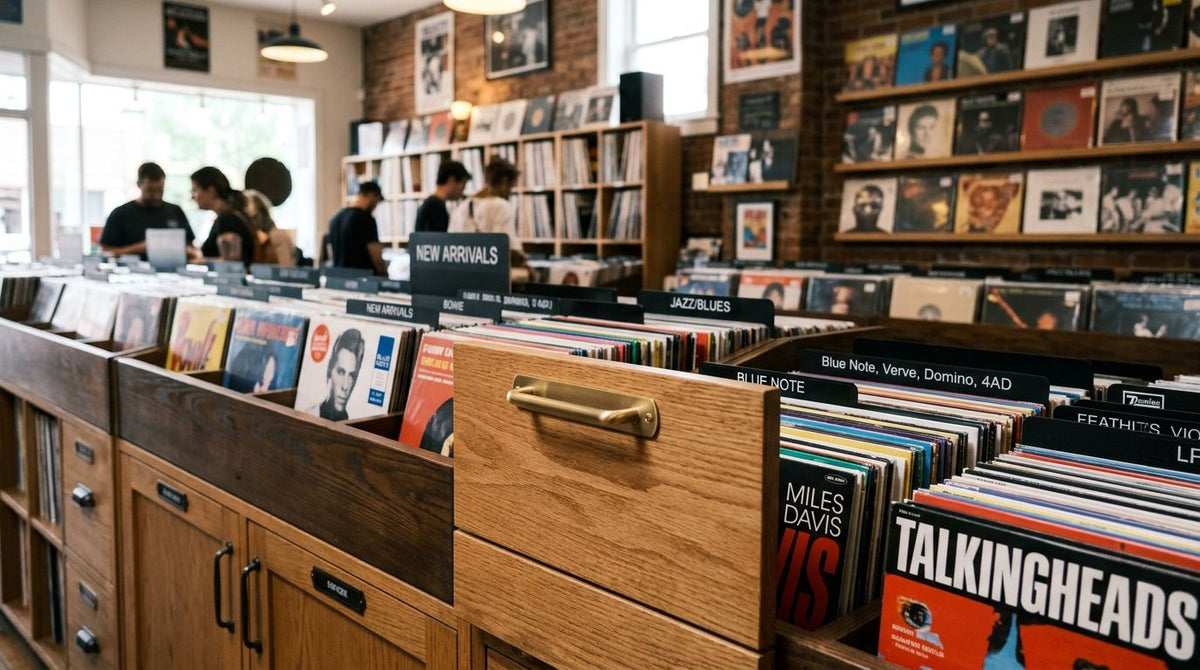
Record store cabinet hardware is the knobs, pulls, and latches installed on browser bins, LP display cases, and back-bar cabinets — chosen to survive thousands of daily grabs a year without loosening, tarnishing, or looking beat down under fluorescent lighting. A record store puts far more daily wear on a pull than a home kitchen does: customers flip through crates for minutes at a time, staff restock bins constantly, and locking cabinets near the register need hardware that actually holds under pressure, not just looks period-appropriate.
- Bar pulls and appliance pulls outlast small knobs on high-traffic vinyl browser bins in 2026 retail buildouts.
- Cabinet hardware for record store display should include latches on any bin holding rare or collectible stock.
- Knobs.co carries 50,000+ SKUs, enough to match finish across every fixture in a single order.
- Test finish under store lighting with samples before ordering hardware for a full bin run.
Why cabinet hardware matters for record stores
A record store's cabinets get handled differently than a residential kitchen ever will. Customers grip a pull, drag a divider forward, flip through 20-30 records, then let go — that cycle repeats hundreds of times a day across a busy shop floor. Decorative knobs sized for a drawer that gets opened twice a day will loosen fast under that kind of repeated pull-and-release motion.
Security matters too. Bins holding first pressings or graded collectible vinyl often sit in cabinets near the register, and those need a latch, not just a pull, to keep casual browsing from turning into shrink. Finish matters as much as function — most record stores lean into a retro or industrial look, and flat black, oil rubbed bronze, and honey bronze finishes read as intentional rather than mismatched.
Measure your bin depth and drawer overlay before ordering
Bin depth and drawer overlay dictate pull length and projection, and getting this wrong means reordering mid-buildout.
- Measure drawer face width and divide by 3 to find a proportional pull length
- Check overlay type (full, partial, inset) before choosing screw spacing
- Confirm center-to-center distance on any pull you're replacing, not just the length
- Note cabinet material thickness — MDF face frames need shorter screws than solid wood
Match pull style to your daily foot traffic
High-traffic bins need a pull built for a whole-hand grip, not a fingertip pinch.
- Bar pulls give a full-hand grip for bins customers dig through repeatedly
- Appliance pulls, built for oversized doors, suit wide LP crate fronts that need two-handed leverage
- Small knobs work fine on low-traffic cabinets like back-office supply storage
- Cup pulls suit narrow drawer fronts where a protruding pull would snag on adjacent bins
The Pennington bar pull at 6 5/16 inches center-to-center is sized for a standard bin front and gives a full-hand grip that a small knob can't match on a fixture that gets touched hundreds of times a shift.
Choose a finish that hides fingerprints and resists tarnish
Store lighting and constant hand contact expose weak finishes fast — a polished chrome pull shows every fingerprint under fluorescent track lighting within a week.
- Flat black and matte finishes hide oils and smudges better than polished or bright finishes
- Oil rubbed bronze and honey bronze age gracefully and hide handling marks
- Brushed satin nickel splits the difference — muted enough to hide prints, bright enough to read clean
- Avoid unlacquered brass on high-traffic bins unless the store wants a patina that darkens with handling
Lock down high-value bins with cabinet latches
Any cabinet holding graded, rare, or high-margin stock should have a latch, not just a pull — a pull alone doesn't stop a browser from opening a cabinet that should stay closed after hours or during restocking.
- Add a latch to any bin or case near the register holding collectible or graded stock
- Pick a latch finish that matches the surrounding pull hardware, not a mismatched hardware store stand-in
- Confirm the latch depth clears any interior dividers or crate rails before installing
- Test the catch tension — too loose and the door drifts open under its own weight
The Additions cabinet latch in flat black is a 2-inch latch built to pair with matching flat black pulls, giving a locked bin the same finish as the rest of the fixture instead of a bolted-on afterthought.


Order samples before you commit to a full bin run
Catalog photos never show how a finish behaves under a store's actual lighting rig — a warm honey bronze can read closer to gold under LED track lighting than it did in a product photo.
- Order a sample of the exact finish and hold it against the fixture under store lights
- Compare two finish options side by side rather than trusting memory between visits
- Check how the sample reads against both wood-tone and painted bin fronts
- Confirm the pull's grip feel by hand — measurements don't capture comfort
Knobs.co ships free samples so a shop owner can test a finish under actual store lighting before ordering enough hardware to fit out every bin in the building — a faster path than guessing from a swatch photo alone.
Budget hardware quantity across every fixture, not just the counter
A lot of buildouts price out the register counter and forget the back-wall bins, then run short mid-project with a mismatched second batch.
- Count every drawer, bin, and cabinet face in the buildout before ordering, not just the visible counter
- Order 5-10% extra to cover installation errors or future fixture additions
- Standardize on one or two finishes across the whole floor to simplify reordering later
- Keep the SKU numbers on file so a 2026 restock matches the original finish exactly
Comparing hardware options for a record store buildout
| Option | Best For | Key Limitation |
|---|---|---|
| Bar pull | High-traffic browser bins needing a full-hand grip | Longer profile needs more clearance between stacked bins |
| Appliance pull | Extra-wide LP crate fronts and double-door cases | Overkill on narrow drawers, wastes proportional balance |
| Small knob | Low-traffic back-office or supply cabinets | Loosens faster under repeated heavy-hand pulling |
| Cabinet latch | Locking cases holding collectible or graded stock | Needs a matching pull nearby for the fixture to read as one design |
Bar pulls and appliance pulls win on any bin customers touch daily; small knobs belong on low-traffic storage, not the browsing floor.
Common mistakes record stores make with cabinet hardware
- Reusing leftover residential knobs sized for occasional use on bins that get gripped hundreds of times a day, then wondering why they loosen within months.
- Skipping latches on register-adjacent cabinets that hold the shop's highest-margin stock, treating a pull as if it were a lock.
- Picking finish from a catalog photo instead of a sample under the store's own lighting, then finding the honey bronze reads gold under LEDs.
- Under-ordering by counting only the visible counter, then reordering mid-buildout and ending up with a mismatched batch from a different production run.
- Ignoring pull length against bin width, forcing customers into an awkward one-finger grip on a bin that should take a full hand.
FAQ
What cabinet hardware works best for vinyl record display bins?
Bar pulls and appliance pulls work best because they give a full-hand grip for customers flipping through crates repeatedly. Small knobs are fine on low-traffic storage but loosen faster on daily-use browser bins.
Should record store shelves use knobs or pulls?
Pulls, not knobs, on any bin customers touch daily — a bar or appliance pull spreads the grip across a full hand instead of two fingers. Knobs still make sense on low-traffic back-office cabinets.
What size pull fits a record bin or LP crate drawer?
A pull around 6 to 12 inches center-to-center suits most standard bin fronts, with wider 24-inch appliance pulls reserved for extra-wide double-door cases. Measure the drawer face and match proportionally rather than guessing.
Do record store cabinets need locking hardware?
Any cabinet holding rare, graded, or high-margin stock needs a latch, since a pull alone won't stop casual access. A 2-inch cabinet latch matched to the surrounding pull finish keeps the fixture looking intentional, not bolted on.
What finish holds up best under retail store lighting?
Flat black, oil rubbed bronze, and honey bronze hide fingerprints and handling marks better than polished chrome or bright nickel. Polished finishes show smudges within days under fluorescent or LED track lighting.
How many pulls does a typical record store need?
It depends on total bin, drawer, and cabinet count across the floor plan, not just the register counter. Count every fixture before ordering and add 5-10% extra to cover installation errors.
Is a bar pull or appliance pull better for a wide LP bin?
An appliance pull suits extra-wide double-door cases where two-handed leverage helps, while a standard bar pull fits single-drawer bin fronts. Match the pull length to the drawer width rather than picking one style for the whole store.
Can I mix finishes across different display fixtures?
Standardizing on one or two finishes across the whole floor simplifies reordering and reads more intentional than mixing five different metals. Save any finish variation for a deliberate two-tone design choice, not leftover stock.
One last thing
The fixture that gets skipped most in record store buildouts isn't the browser bin — it's the latch. Shops that finish out an entire wall of pulls and forget the register-adjacent cabinet holding the graded stock end up adding a latch later as a mismatched afterthought. Order the latch with the rest of the hardware in 2026, in the same finish, and it never looks bolted on.