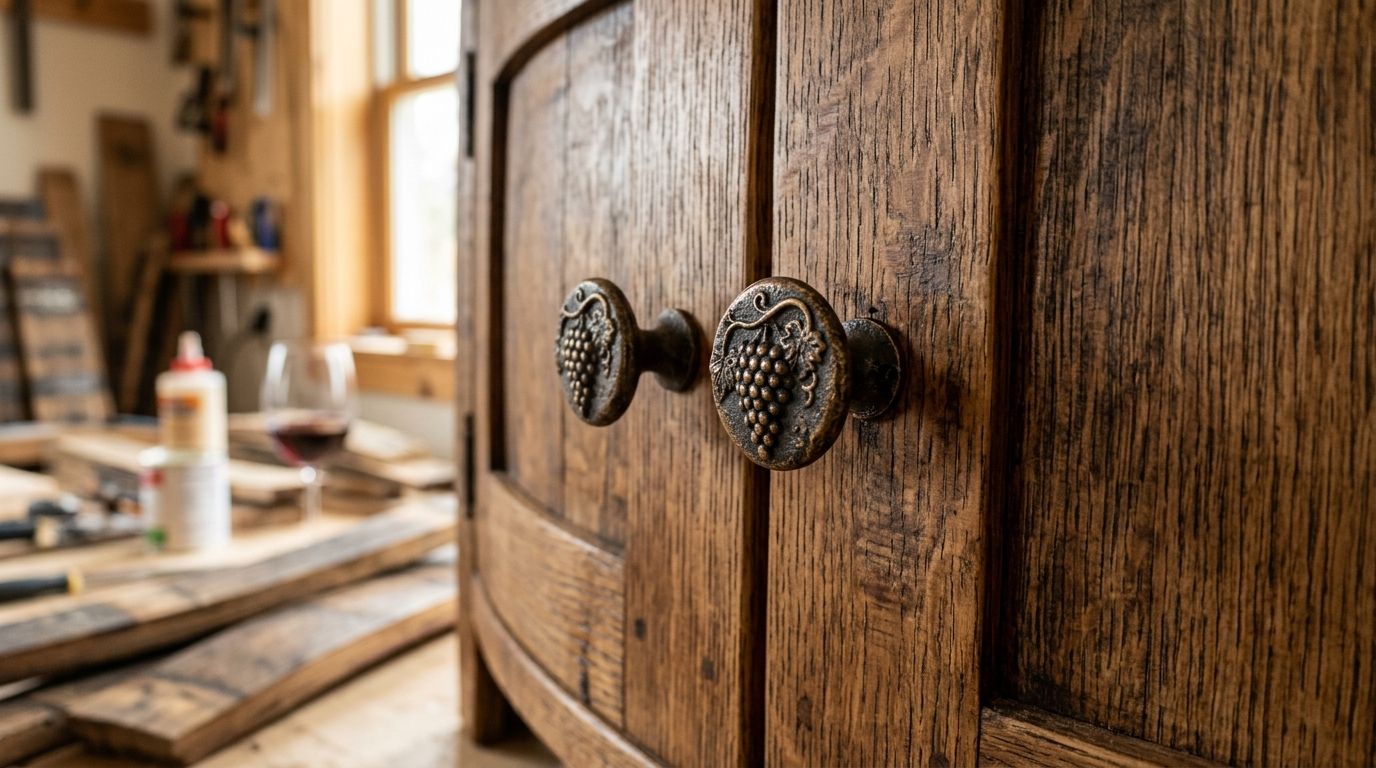
Cabinet knobs for wine barrel furniture are hardware picked to work with curved barrel staves, dark reclaimed oak, and the iron hoops already riveted to the piece — the goal is hardware that reads built into the furniture, not bolted onto it. A wine barrel cabinet, bar, or barrel-head nightstand puts hardware on a surface that was never milled flat, and that changes almost every decision from screw length to finish.
- Cast iron and oil-rubbed bronze cabinet knobs for wine barrel furniture match existing iron hoops better than chrome or brass.
- Barrel staves run roughly an inch thick at the mounting point, thicker than most flat cabinet doors — check screw length first.
- Knobs.co ships free samples before a full order, which matters more on barrel wood since finish varies piece to piece.
- Round knobs suit barrel-head doors; horizontal pulls suit stave-fronted drawers.
Why cabinet knobs matter for wine barrel furniture
Reclaimed wine barrel furniture — barrel-stave cabinets, barrel-head tables with a drawer cut in, wine barrel bars — already carries its own hardware language before you add a single knob. Iron hoops, rivets, and sometimes a charred interior stave visible through a cut section all set the tone. New cabinet knobs and pulls either play into that industrial-rustic look or fight it.
Barrel staves also run thicker than a standard cabinet door — roughly an inch at the mounting point on a stacked-stave build — so a knob screw sized for a 3/4-inch shaker door can bottom out. Pair a cast iron knob with the piece's existing hoops instead of chrome or brass; it reads intentional instead of fighting the black iron already on the barrel. A flat backplate also sits proud on one side of a curved stave and gaps on the other, unlike on a flat panel.
Knobs.co carries cast iron, oil-rubbed bronze, and antique pewter cabinet knobs suited to barrel-stave builds, alongside latches for barrel-head doors that skip pulls entirely. Buyers searching cabinet knobs for wine barrel furniture in 2026 are mostly matching hardware to a piece that already exists, not picking a finish from a blank kitchen — that's the core difference from a standard remodel, and it's why generic "best cabinet knobs" advice doesn't transfer cleanly.
“If the backplate doesn't curve with the stave, the knob looks bolted onto a barrel, not built into a piece of furniture.”
How to choose cabinet knobs for wine barrel furniture
Measure the stave before you order anything
Get the numbers before you shop, not after the box arrives.
- Measure stave thickness at the exact mounting point — stacked-stave builds often run 3/4" to 1-1/4", thicker at seams
- Note the curvature radius so you can rule out flat backplates that won't seat flush
- Check whether the mounting spot lands inside a hoop band or rivet zone before committing to a location
- Use a screw gauge or a scrap offcut to confirm what screw length actually clears the stave from the inside
Pick a finish that matches the metal already on the piece
The barrel's hoops and rivets are already a finish decision — new hardware has to answer to them, not replace them.
- Match iron hoops with a cast iron or oil-rubbed bronze finish rather than polished chrome or bright brass
- Raw, lighter oak pairs well with antique pewter; char-toasted, darker staves hide oil-rubbed bronze scuffs better
- Avoid a shiny finish next to black iron bands — it reads mismatched more often than it reads eclectic
- Read the matching cabinet hardware finish guide before ordering a full set, especially if the piece mixes raw and charred sections
Choose a knob or a pull based on the door style
Barrel geometry decides this one more than personal taste.
- A round barrel-head cut into a cabinet door usually takes one center knob — a pull looks busy on a circular face
- A stave-fronted drawer takes a horizontal pull better than a round knob because it follows the grain and hides slight stave unevenness
- Anything under 6 inches wide stays a knob — a full-size pull overhangs the edge of a narrow drawer
- Double doors split from a barrel head get knobs near the inside edge, not pulls that force a reach across the seam
Space hardware around hoops and rivets, not through them
Drilling into the wrong spot on a barrel piece is harder to fix than on flat MDF.
- Never drill through an iron hoop band — relocate the knob up or down the stave instead
- Keep at least an inch of clearance from any rivet head so the backplate doesn't sit at an angle
- Center the knob on the actual wood panel, not the geometric center of the visible ring — barrel grain often pulls the eye off-center
- Mark the spot with tape and step back ten feet before drilling — curves are harder to judge up close than a flat door face
Order samples before committing to a full set
This is where working with a specialist supplier pays off over guessing from a product photo.
- Reclaimed barrel wood varies batch to batch, so a finish that matched a photo can run warmer or cooler on the actual piece
- Knobs.co ships free samples ahead of a full order, which matters more here than on a standard kitchen remodel in 2026 — hardware already installed on curved wood is a mess to return
- Order at least two finish options if the piece mixes raw wood and charred sections
- Hold the sample against the actual hoops in the room's real light, not under a phone flashlight
Install without splitting the stave
Barrel oak splits more easily than you'd expect once you're past the bark side.
- Pre-drill with a bit slightly smaller than the screw shank — kiln-dried barrel oak is split-prone near the seams
- Back the drill out slowly on the last quarter-turn — curved wood doesn't give the same resistance feedback as flat MDF
- Use a hardware jig once you're placing more than four knobs — barrel curvature makes eyeballing spacing unreliable past the first couple of pieces
- Test the pilot hole on an offcut stave first if the piece came from a working barrel rather than new-cut reclaimed stock


Cabinet knob and pull options for wine barrel furniture
| Hardware option | Best for | Key limitation |
|---|---|---|
| Cast iron knob (like Britannia's cast iron knob) | Heavy barrel-stave doors that need rustic heft | Adds noticeable weight; needs a solid pilot hole |
| Oil-rubbed bronze pull (like the oil-rubbed bronze pull) | Barrel-head drawer fronts where char marks already show | Shows fingerprints more than a matte finish |
| Antique pewter knob | Pale, raw reclaimed oak with little existing contrast | Patina shifts over a few years of handling |
| Rustic-finish latch | Barrel-stave doors where you want no visible pull | No obvious grip point for a first-time user |
Verdict: for most barrel-stave builds shipped in 2026, a cast iron or oil-rubbed bronze knob from Knobs.co wins — it matches the metal that's already on the piece instead of fighting it.
Common mistakes buyers make with wine barrel cabinet knobs
- Bolting a flat backplate onto a curved stave — it rocks against the wood and works loose within months
- Picking a shiny finish like polished chrome or bright brass that fights the barrel's existing iron hoops
- Skipping the screw-length check and stripping the pilot hole on the first drawer
- Ordering a full set straight from a photo — reclaimed barrel finish shifts piece to piece, even within the same barrel
- Centering hardware on the visible barrel ring instead of the actual door panel, which looks tilted once the door is hung
FAQ
What are the best cabinet knobs for wine barrel furniture?
Cast iron and oil-rubbed bronze cabinet knobs work best for wine barrel furniture because they match the iron hoops already on the piece. Antique pewter is the better call on pale, raw reclaimed oak with less existing metal contrast.
Do standard cabinet knobs fit curved barrel staves?
Standard flat-backed knobs don't seat flush on a curved stave; the backplate sits proud on one side and gaps on the other. Look for a smaller knob profile or accept a slight gap rather than forcing a large flat backplate.
What screw length do I need for wine barrel cabinet doors?
Barrel staves run roughly an inch thick at the mounting point on stacked-stave builds, thicker than a typical 3/4-inch cabinet door. Measure the actual stave before ordering hardware so the screw fully clears the wood.
Should I use knobs or pulls on barrel-stave furniture?
Round barrel-head doors usually take a single center knob, while stave-fronted drawers take a horizontal pull that follows the grain. Anything under 6 inches wide stays a knob since a full-size pull overhangs the edge.
What finish matches iron barrel hoops?
Cast iron and oil-rubbed bronze pair with existing iron hoops better than polished chrome or bright brass. Antique pewter is the softer option for lighter, raw reclaimed oak.
Can I order a sample before buying cabinet hardware for barrel furniture?
Yes — Knobs.co ships free samples ahead of a full order, which matters more on reclaimed barrel wood since finish tone shifts piece to piece. Order at least two finish options if the furniture mixes raw and charred wood.
How do I install knobs without splitting the barrel stave?
Pre-drill with a bit slightly smaller than the screw shank and back the drill out slowly on the last quarter-turn. Kiln-dried barrel oak splits more easily near seams than flat cabinet-grade MDF.
Is oil-rubbed bronze or antique pewter better for reclaimed barrel wood?
Oil-rubbed bronze hides scuffs better on darker, char-toasted staves, while antique pewter suits lighter raw oak with less existing contrast. Match the finish to the wood tone and the hoops together, not just one or the other.
One last thing
Most wine barrel furniture builders underrate how much the barrel's original toast level changes hardware choice. A heavily charred interior stave reads almost black under lamp light, and a light finish like polished nickel disappears against it instead of standing out. If the piece leans dark, go one shade darker on the hardware than feels intuitive — it reads deliberate once it's mounted instead of like an afterthought bought in 2026 to finish the project.