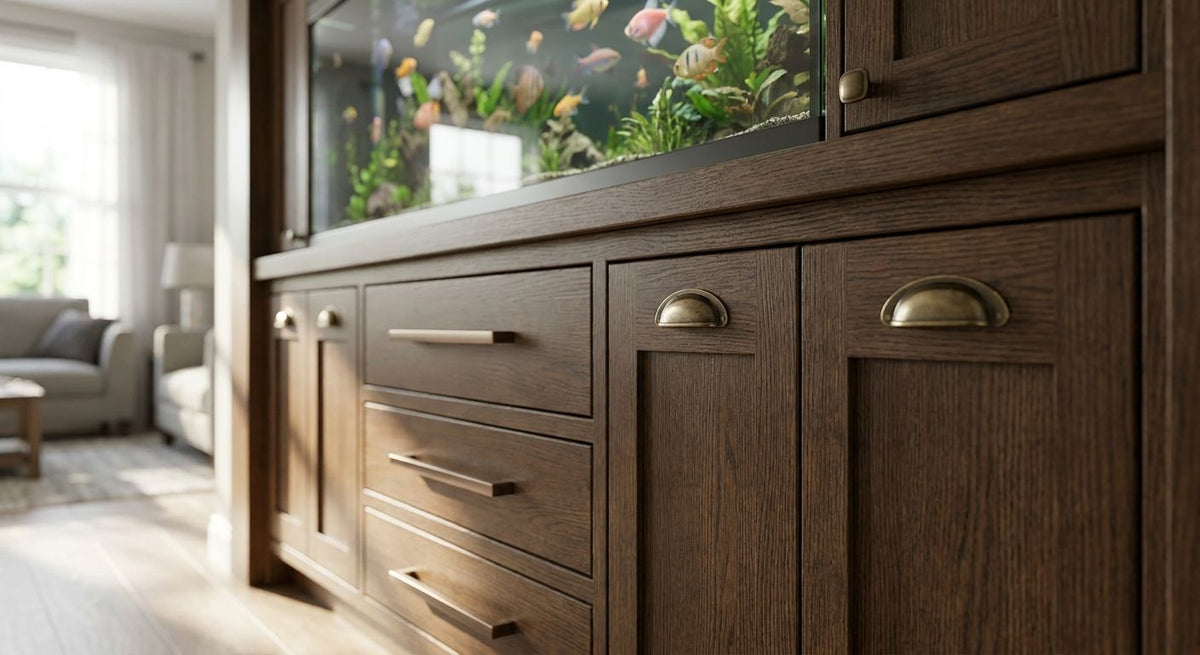
Cabinet pulls for aquarium stand cabinetry need to survive standing humidity, splash from water changes, and daily hands-on access to filtration gear — not just match a kitchen aesthetic. A stand built to hide a canister filter, sump, or dosing pump behind a door works differently than a vanity or kitchen base cabinet, and the hardware has to keep up with that difference or it loosens, corrodes, or rattles within a season.
- Stainless steel and PVD-finished pulls hold up best on cabinet pulls for aquarium stand cabinetry exposed to splash and standing humidity.
- Knobs.co stocks bar pulls and cabinet latches sized for wide equipment-access doors, not just standard 3-inch kitchen spacing.
- Skip unlacquered brass and raw bronze near saltwater spray in 2026 builds — both finishes patina unevenly with repeated water contact.
- Add a latch, not just a pull, on any door hiding a return pump or sump that vibrates during normal operation.
Why cabinet pulls matter for aquarium stand cabinetry
A kitchen cabinet door opens a handful of times a day. A stand door hiding a sump, protein skimmer, or dosing pump gets opened for water testing, dosing refills, and filter maintenance several times a week — usually with wet hands. That access pattern wears out undersized pulls and loose latches faster than it wears out standard kitchen hardware, and it doesn't slow down once the tank is established.
Humidity is the other variable a kitchen-hardware guide won't cover. Standing water and evaporation inside a closed stand keep moisture around the hardware constantly, closer to the exposure covered in Knobs.co's guide to cabinet hardware for high-humidity spaces than anything in a typical kitchen remodel. Reef and saltwater setups push that further — salt spray accelerates corrosion on plated metals faster than freshwater splash does. On a stand, finish choice matters as much as pull size, and getting either wrong shows up within a season, not a decade.
How to choose cabinet pulls for aquarium stand cabinetry
Measure the door before you pick a pull length
Wide equipment-access doors — the kind that hide a canister filter or a sump — need a longer pull than a standard 12-inch kitchen door, and guessing on length is the fastest way to end up with a pull that fights the door's own weight.
- Measure the door width and subtract roughly 2 inches on each side for a proportional pull length
- Use bar pulls in the 6-inch to 12-inch range for standard stand doors
- Go to 18-24 inch appliance-style pulls for oversized doors hiding sumps or reservoirs
- Confirm the door has enough flat rail space for the mounting screws before ordering
- Recheck spacing against the door stile width, not just the overall cabinet width
Pick a finish rated for splash and standing humidity
Not every finish that looks good in a kitchen photo holds up next to a tank, and the difference between a finish that lasts and one that doesn't shows up in the first few months, not years down the line.
- Stainless steel and PVD (physical vapor deposition) finishes resist corrosion best in constant-humidity cabinets
- Brushed satin nickel and polished chrome are solid mid-range choices for stands without direct saltwater exposure
- Unlacquered brass and raw bronze patina with repeated water contact — expect the finish to change, not stay put
- Avoid finishes marketed strictly for dry kitchen use if the stand sits under a sump with any drip history
Match pull style to the equipment behind the door
The pull has to work for the task behind the door, not just the cabinet face, which is a different design brief than picking hardware for a pantry or vanity.
- Bar pulls give the most leverage for heavy doors that swing against gravity
- T-handle pulls suit narrower doors accessed one-handed while holding a test kit or bucket
- Cup pulls work on shallow drawers storing dosing supplies, test strips, or spare tubing
- Reserve appliance-style pulls for doors 24 inches or wider hiding sumps or large reservoirs
Add cabinet latches on doors that vibrate
A return pump or air pump running behind a door transmits low-level vibration that a pull alone won't manage over months of continuous run time.
- Install a latch on any door directly behind a running pump, not just a pull
- Pick a latch finish that matches the pull to keep the stand looking intentional
- Test the latch tension by hand before committing to a full-door hardware order
- Skip latches on doors you open daily for dosing — the extra step slows down routine access
Knobs.co carries both pulls and latches across matching finish families, which makes it easier to hardware an entire stand — equipment doors, drawer fronts, and access panels — without hunting for a second vendor mid-project. That matters more on a stand than a kitchen, since a mismatched latch finish stands out next to a lit tank in a way it wouldn't on a pantry door.
Check hole spacing against your existing holes
Converting a stock cabinet box, a media console, or a repurposed credenza into an aquarium stand means working around holes that are already there, and that's a step a lot of DIY builds skip until the pulls arrive.
- Measure center-to-center spacing on any existing holes before ordering new pulls
- Choose a replacement pull with matching hole spacing to avoid drilling and filling
- If spacing doesn't match, pick a pull long enough to cover old holes with its backplate
- Check screw length against the actual door or panel thickness, which is often thicker on a custom-built stand
Order samples before you commit to a full order
Finish photos shift under aquarium lighting, especially blue reef-spectrum bulbs that can make warm metals read cooler than they actually are once the tank is running.
- Hold a physical sample against the stand under the tank's actual lighting before ordering the full set
- Compare nickel, chrome, and stainless samples side by side — they read differently under LED reef lighting
- Order one latch and one pull sample together to check they match as a pair
- Confirm the finish under both daytime room light and the tank's evening lighting cycle


Cabinet pull options for aquarium stand cabinetry
Verdict: stainless and PVD-finished bar pulls, sized to the door and paired with a matching latch on any vibrating door, is the safest cabinet pull setup for aquarium stand cabinetry in 2026.
| Option | Best for | Key limitation | Verdict |
|---|---|---|---|
| Long bar pulls (12"+) | Wide doors hiding a canister filter or sump | Needs blocking behind thin apron doors to stop flex | Buy |
| Amwell Appliance Pull 24 Honey Bronze | Extra-wide panels hiding large sumps or reservoirs | Needs precise hole layout at install on a large panel | Buy |
| Cup pulls | Narrow drawers storing dosing supplies and test kits | Limited grip when hands are wet | Consider |
| Additions Cabinet Latch 2 Inch Flat Black | Securing doors against pump vibration | Adds a step to daily-access doors | Buy for equipment doors, skip on daily-use doors |
| T-handle pulls in unlacquered brass | Stands with no direct splash exposure | Patina shifts quickly near any water contact | Skip near splash zones |
Common mistakes when choosing hardware for aquarium stand cabinets
These mistakes show up on aquarium stands built in 2026 about as often as they did on stands built a decade ago — the tank changes, the hardware problems don't.
- Undersizing the pull on a wide equipment door. A 3-inch kitchen-standard pull on a 30-inch sump door forces a two-hand pull that stresses hinges and screws over time.
- Choosing an unlacquered or raw finish for a splash zone. These finishes are designed to age on purpose, and next to a tank they age fast and unevenly instead of gaining an even patina.
- Skipping the latch on a door that vibrates. A pull alone won't stop a door from working itself open next to a running return pump, and a loose door next to a tank is worse than a loose kitchen door.
- Ignoring hole spacing when repurposing furniture into a stand. Media consoles and credenzas built for a TV, not a tank, rarely match standard cabinet hole spacing, which forces drilling new holes anyway.
- Ordering one finish sight-unseen for the whole stand. Reef lighting shifts how nickel, chrome, and stainless read — check a sample under the tank's own light before committing to a full order.
FAQ
What's the best cabinet pull finish for an aquarium stand?
Stainless steel and PVD finishes handle standing humidity and splash best on aquarium stand cabinetry in 2026. Brushed satin nickel and polished chrome are solid mid-range options for stands without direct saltwater exposure.
Do aquarium stands need cabinet latches in addition to pulls?
Any door directly behind a running pump benefits from a latch, since low-level vibration works pulls loose over time. Skip latches on doors opened daily for dosing or feeding, since the extra step slows down routine access.
Is unlacquered brass a bad choice for aquarium stand hardware?
Unlacquered brass patinas with repeated water contact, so it changes appearance faster near a stand than it would in a dry kitchen. It still works on stands with no direct splash exposure, but expect the finish to shift over months, not stay static.
What size pull works for a sump access door?
Doors 24 inches or wider hiding a sump or reservoir generally need an 18 to 24 inch appliance-style pull rather than a standard 6 to 12 inch bar pull. Measure the actual door width and leave roughly 2 inches of clearance on each side.
Can I reuse a media console or credenza as an aquarium stand?
Yes, but check existing hole spacing before ordering new hardware, since furniture built for a TV rarely matches standard cabinet hole spacing. A pull with a wider backplate can cover old holes without drilling and filling.
How often should aquarium stand cabinet hardware be checked?
Check pulls and latches on equipment doors every few months, since pump vibration and closed-cabinet humidity loosen screws faster than in a dry cabinet. A quarterly check catches a loose pull before it becomes a broken one.
Should aquarium stand hardware match kitchen hardware in the same house?
It doesn't need to match exactly, but keeping pulls and latches in the same finish family across the stand looks intentional rather than assembled from leftovers. Matching finish across the pulls and latches on the same door matters more than matching the rest of the house.
One last thing
Most aquarium stands start life as a repurposed kitchen base cabinet or a media console, not a purpose-built enclosure, which means the hole spacing was drilled for a design decision that had nothing to do with a tank. Before ordering a full set of pulls for a 2026 build, pull one door and check its existing spacing first — it decides more of the shopping list than the finish does.