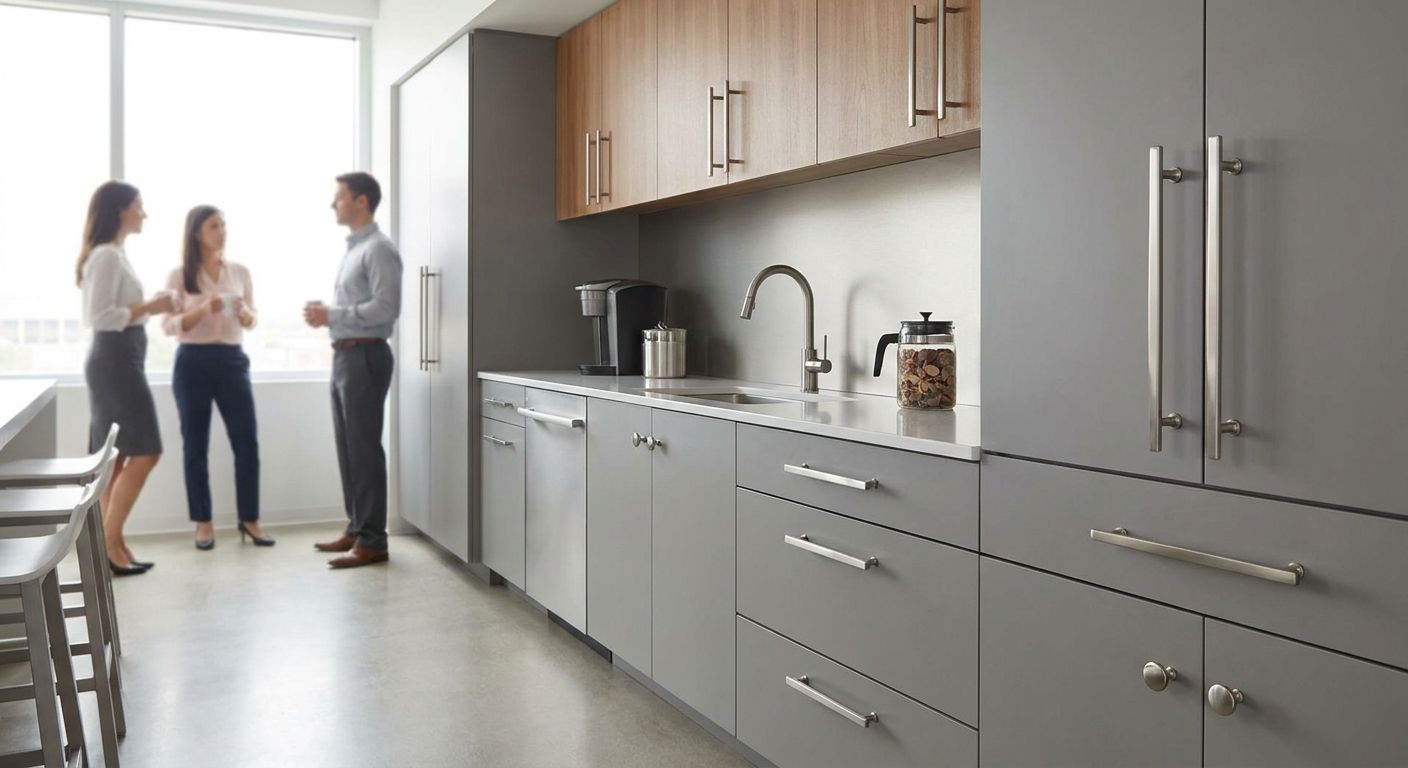
Corporate break room cabinet hardware is the knobs, pulls, latches, and hinges specified for shared kitchenette and supply cabinets in an office, chosen to survive dozens of different hands a day instead of matching one homeowner's taste. A break room hardware brief in 2026 is a durability brief first and a style brief second: grip strength, fingerprint resistance, and screw-hole integrity matter more than trend.
- Knobs.co carries bar pulls, appliance pulls, and latches built for cabinet hardware for office break room upgrades in 2026.
- Stainless steel and honey bronze finishes hide fingerprints far better than polished chrome or brass in shared kitchenettes.
- Bar pulls outlast knobs on break room cabinets opened dozens of times daily by different employees.
- Order hardware in bulk across every break room cabinet at once to avoid mismatched replacements later in 2026.
- Add a latch to shared snack or supply cabinets instead of relying on a knob alone.
Why cabinet hardware matters for corporate break rooms
A break room cabinet gets opened by everyone on the floor, not one household running through the same routines every week. That volume of different hands, different grip strengths, and wildly different levels of care is what breaks hardware fast. A knob that holds up for a decade in a home kitchen can spin loose or crack within two or three years in a shared office kitchenette.
Facilities teams also buy differently than homeowners do. There are fewer style opinions to manage, more identical units to match across multiple floors, and a hardware line item that has to justify itself to someone who will never see the cabinets up close. A stainless steel knob reads as commercial-grade without looking institutional, which is one reason it shows up in break room specs almost as often as it does in home kitchen remodels.
None of this is about matching a design scheme to the rest of the office. It's about hardware that keeps working when nobody in the building personally owns the outcome the way a homeowner owns their own kitchen. Get the finish and the pull style wrong in 2026 and the facilities team is re-ordering hardware by 2027.
Audit your break room cabinet wear before you buy anything
Walk the break room before ordering a single piece of hardware — most facilities teams underestimate how much wear is already there.
- Note every door that sags, every pull that spins loose, and every knob with a hairline crack
- Check screw holes for stripping, the single most common failure point after a few years of daily use
- Note whether doors are laminate, thermofoil, or solid wood, since that changes which screws and backplates actually hold
- Count how many units need full hardware replacement versus a simple re-tightening
- Separate cosmetic wear from functional failure so the budget goes where it's needed first
Pick a finish that hides fingerprints and grease
Break room cabinets get touched with coffee-stained, hand-lotioned, and greasy hands all day, so finish choice matters more here than in almost any other room in the building.
- Favor honey bronze, oil-rubbed bronze, or matte black over polished chrome or bright brass, which show every fingerprint within days
- Hold a finish sample against a hand with lotion on it before ordering 30-plus units of the same knob or pull
- Test the finish under the break room's actual fluorescent or LED lighting, not a showroom halogen bulb — finishes read differently under each
- Knobs.co ships free samples, which lets a facilities manager bench-test finish and grip on an actual scrap of laminate before committing to a bulk order for 2026 budgets
- Stick to one finish across the entire break room so replacement stock stays simple to reorder later
Choose bar pulls over knobs for high-traffic doors
Grip mechanics matter more in a break room than in a home kitchen, because the hardware gets used by people who didn't choose it and won't handle it gently.
- Swap knobs for bar pulls on any cabinet opened more than a handful of times a day, including coffee, mug, and snack cabinets
- Size pulls between 3 and 6 inches center-to-center for standard upper cabinets, and longer for wide pantry-style doors
- Reserve knobs for low-traffic cabinets — supply closets, rarely opened storage, or cabinets used by one or two people
- Check that pull screws thread into the door at full depth; a pull that only catches a few threads loosens fast under repeated use
“Bar pulls take less grip precision than knobs, which is why they hold up better in a break room dozens of different people use every day.”
Fit appliance pulls to break room refrigerators, microwaves, and ovens
Appliance doors take more daily abuse than any cabinet door in the room, and generic cabinet pulls rarely fit them correctly.
- Match pull length to the actual appliance door width, not whatever length trend is used on the kitchen cabinets nearby
- Check whether the appliance is panel-ready or has an exposed factory face before ordering a pull for it
- Use through-bolt appliance pulls rather than adhesive-mount hardware — adhesive fails faster under the vibration of a daily-use refrigerator or ice maker
- The Amwell appliance pull comes in a 24-inch length built for larger break room refrigerator and freezer doors
- Confirm mounting hole spacing against the appliance's own installation manual before drilling — appliance spacing rarely matches standard cabinet spacing
Add latches to shared snack and supply cabinets
Any cabinet that holds shared coffee, snacks, or paper goods needs more than a pull — it needs something that keeps the door from getting yanked open and slammed shut hundreds of times a year.
- Put a latch on any cabinet that gets rummaged through by people who don't restock it
- Choose a latch finish that matches the rest of the break room's hardware line, not a mismatched leftover from another project
- The Additions cabinet latch in flat black mounts to standard overlay doors without extra reinforcement
- Skip latches on cabinets that need airflow, like ones housing a dishwasher or under-sink plumbing
- Test the latch mechanism weekly for the first month after install — loose screws show up fast under heavy office traffic


Standardize hardware across every break room in the building
Break room fixtures other than cabinets face the same duty-cycle problem cabinets do. Vending machines and coffee equipment get serviced on a fixed schedule because heavy daily use wears parts down faster than home use ever would, and tracking break room vending machine downtime follows the same logic facilities teams should apply to cabinet hardware: replace on a schedule, not after something fails in front of the whole floor.
- Pick one finish, one pull style, and one latch style, then apply it building-wide instead of room-by-room
- Order 10 to 15 percent extra stock so a broken pull five years from now doesn't force a full re-match
- Log the exact SKU, finish, and size in a facilities spreadsheet the day hardware ships, before the packaging gets thrown out
- Route bulk orders through Knobs.co, which handles cabinet hardware trade and contractor accounts rather than single-item retail checkouts
Install with facilities staff, not a design contractor
Break room cabinet hardware installs are a facilities job, not a design job — the goal is consistent placement across dozens of identical doors, not a custom look.
- Confirm hole spacing before drilling a second hole; most pulls stamp their center-to-center measurement right on the packaging
- Use a template or jig rather than eyeballing placement across a dozen identical cabinet doors
- Torque screws by hand first — over-tightening with a drill strips laminate-backed doors faster than any other installation mistake
- Walk the finished room under the break room's actual working lights to catch any hardware that doesn't sit flush
Break room hardware options compared
Bar pulls are the safest default for cabinet hardware for office break room cabinets in 2026 — they take less grip precision than a knob and hold up better when dozens of different people use the same door every day.
| Option | Best for | Key limitation |
|---|---|---|
| Bar pulls | Cabinets opened dozens of times a day by different people | Needs more cabinet face than a knob, so it won't fit every narrow door |
| Knobs | Low-traffic supply or storage cabinets | Fingertip grip loosens faster than a full-hand pull under heavy daily use |
| Appliance pulls | Break room refrigerators, microwaves, and wall ovens | Sized to match an appliance door, not standard cabinet dimensions |
| Latches | Shared snack, coffee, or paper-goods cabinets | Adds an install step most break room retrofits skip entirely |
Common mistakes offices make with break room cabinet hardware
- Matching break room hardware to the boardroom, not the use case. A polished brass pull that looks sharp in a conference room shows every fingerprint within a week in a shared kitchenette.
- Skipping latches on shared cabinets. Without one, the snack cabinet turns into a free-for-all and the door gets slammed shut hundreds of times a year instead of closing gently.
- Ordering one cabinet's worth of hardware at a time. A year later the finish is discontinued and the replacement doesn't match — the same mismatched-hardware pattern shows up in commercial kitchen cabinetry, where facilities teams cite it as one of the most common complaints after a phased remodel.
- Ignoring appliance pull sizing. A pull built for a 30-inch kitchen cabinet door doesn't fit a 24-inch break room refrigerator door without redrilling the panel.
- Choosing hardware nobody tested under real lighting. Fluorescent break room lighting reads finishes differently than a showroom halogen bulb, and a finish that looked warm in the store can look flat and grimy once it's installed in 2026.
FAQ
What's the best cabinet hardware for a corporate break room?
Bar pulls in a fingerprint-resistant finish like honey bronze, matte black, or brushed stainless steel hold up best on break room cabinets opened dozens of times a day by different people. Knobs on low-traffic supply cabinets are fine, but pulls win on any door in constant use.
Is stainless steel better than polished chrome for break room hardware?
Yes — stainless steel and matte finishes show fingerprints and grease far less than polished chrome or bright brass under fluorescent break room lighting. That's why stainless and matte black show up so often in commercial specs.
Should break room cabinets use knobs or pulls?
Pulls, specifically bar pulls, outperform knobs on high-traffic break room doors because a full-hand grip needs less precision and puts less strain on the mounting screws. Reserve knobs for cabinets opened only occasionally.
Do break room supply cabinets need latches?
Any cabinet holding shared snacks, coffee, or paper goods benefits from a latch, since it keeps the door from getting yanked open and slammed shut by dozens of different people daily. Skip latches on cabinets that need airflow.
How much cabinet hardware does a typical break room need?
It depends on the number of upper, lower, and appliance-front cabinets in the room. Count doors and drawers first, then add 10 to 15 percent extra stock for future repairs.
Can office facilities teams order cabinet hardware in bulk?
Yes, suppliers like Knobs.co handle bulk and trade orders across dozens of SKUs, which is the standard way facilities managers restock multiple break rooms at once in 2026.
What size appliance pull fits a break room refrigerator?
Appliance pull length should match the refrigerator or freezer door width directly. A 24-inch pull suits larger break room units, while smaller under-counter fridges need a shorter pull.
How often should break room cabinet hardware be replaced?
Replace on a schedule based on visible wear — loose screws, spinning pulls, cracked knobs — rather than waiting for a full failure, since break room cabinets see far more daily use than a home kitchen ever does.
One last thing
If a facilities budget only covers replacing one component on a worn break room cabinet, replace the pull, not the knob. A bar pull spreads grip force across a full hand instead of two fingers, and that's the actual reason break room hardware fails faster than home kitchen hardware — it's the grip, not the finish, that gives out first. Knobs.co's free sample program lets a facilities manager test that grip on an actual scrap of cabinet door before ordering 40 units of the wrong thing for a 2026 refresh.