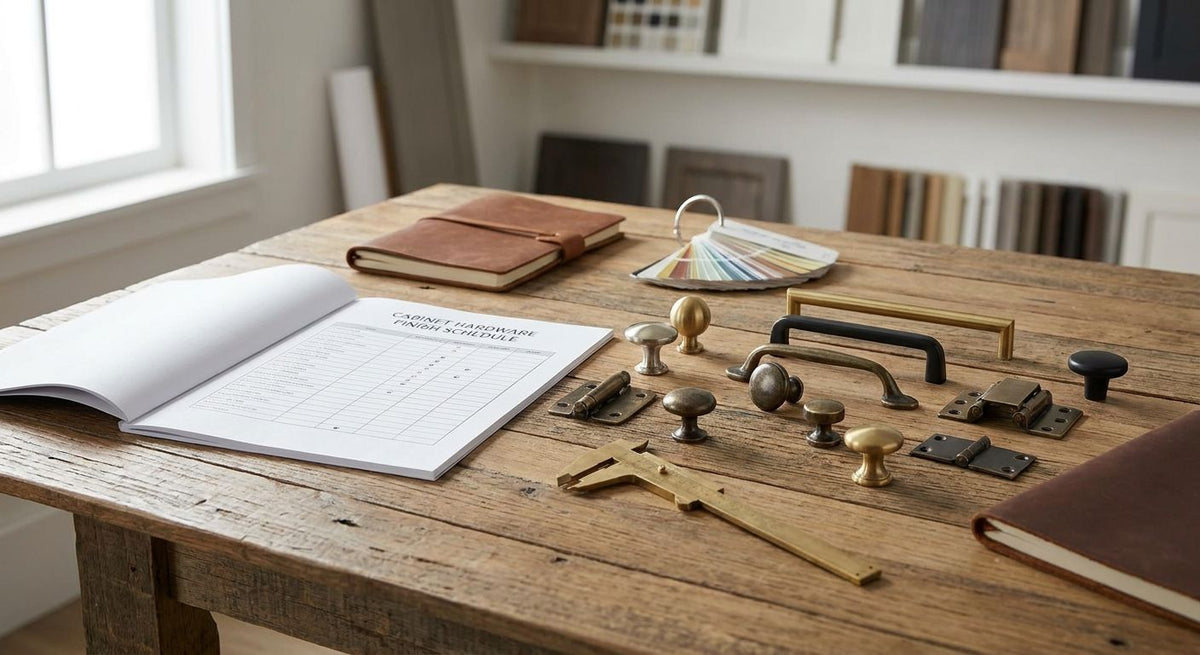
A cabinet hardware finish schedule is the single document that locks every knob, pull, hinge, and latch on a project to one finish, one size, and one zone before anyone picks up a drill in 2026. Skip it and you end up ordering twice — once for what you thought you needed, once to fix the mismatched sheen between brands after install.
- A cabinet hardware finish schedule lists zone, hardware type, finish, and center-to-center size row by row before you order in 2026.
- Most 2026 kitchen remodels use exactly two finishes total: one primary and one contrast accent, never three or more.
- Order samples before finalizing any schedule — mismatched sheen between brands is the top cause of reorders.
- Knobs.co stocks 50,000+ SKUs across major brands, so one schedule can source pulls, hinges, and latches from a single supplier.
Why this matters
A finish schedule isn't paperwork for its own sake — it's the thing that stops a contractor from installing brushed nickel hinges on a matte black pull run because nobody wrote down the plan. On a full kitchen, that mistake means pulling doors back off, patching screw holes, and re-ordering hardware on a rush timeline. On a multi-room remodel with a kitchen, two bathrooms, and a laundry room, it's the only way to keep finish decisions consistent across rooms that get designed weeks apart.
Designers and contractors who work multiple units a year already do this by habit. If you're doing it once, for your own house, in 2026, the schedule is what keeps a good finish decision from turning into three separate finish decisions made under deadline pressure. The guide to choosing a cabinet hardware finish covers how to pick the finish itself — this page covers how to document it once you have.
What goes into a cabinet hardware finish schedule
The schedule is a simple table, not a design document. Every row needs four things: the zone, the hardware type, the finish, and the size. Here's a working example structure pulled from a typical two-finish kitchen and bath project:
| Zone | Hardware Type | Finish | Typical Size (CC) |
|---|---|---|---|
| Kitchen perimeter | Pulls | Primary finish (honey bronze, satin nickel) | 3 3/4" to 6 5/16" |
| Kitchen island | Bar pulls | Contrast/accent finish | 8 13/16" to 12" |
| Appliance panels | Appliance pulls | Match island contrast finish | 12" to 24" |
| Bathroom vanity | Knobs | Polished or brushed nickel | 1 1/4" to 1 3/8" |
| Laundry / mudroom | Latches or knobs | Utility finish (oil-rubbed bronze, flat black) | 2" |
Those size ranges aren't arbitrary — they reflect real center-to-center spacing you'll find across common pull and appliance-pull runs, from a 3 3/4" cabinet pull up to a 24" appliance pull for a wall oven or panel-ready fridge. Write the actual product name and finish code in each row once you've picked it, not just "nickel" — finish names vary by manufacturer and "satin nickel" from one brand won't match "brushed satin nickel" from another under kitchen lighting.
How to build the schedule in 5 steps
- Walk the space and list every cabinet run, drawer bank, and appliance panel that needs hardware — kitchen perimeter, island, appliance garage, pantry, powder room, primary bath, laundry. Nothing gets a finish assigned until it's on the list.
- Assign one primary finish per zone cluster. Most 2026 remodels run one finish through the kitchen and adjoining living spaces, with a single contrast finish reserved for an island or one accent wall of cabinetry. Two finishes total, not three.
- Order samples before locking the schedule. A finish that reads warm on a screen can read flat under LED under-cabinet lighting. The cabinet hardware samples guide for designers covers how to request and compare samples before committing a whole order to one finish.
- Match hinges and latches to the pull's finish family, not the cabinet box color. Hinge finish options are usually more limited than pull options, so a matte black pull run commonly pairs with oil-rubbed bronze or flat black hinges rather than an exact-match SKU.
- Calculate quantities per opening before ordering, factoring in doors, drawers, and any appliance panels. The guide to calculating cabinet hardware quantities walks through counting doors and drawers so the schedule ships with an order count next to every row, not just a finish.


Verdict: a finish schedule with a two-finish rule, a size column, and a quantity count wins over a mental note every time — it's the difference between one order and three.
Why finish choice varies across a project
- Door style — shaker doors expose more hardware surface area than flat-front euro doors, which changes how much a finish reads from across the room.
- Existing fixture finishes — faucets, lighting, and plumbing already installed narrow the finish field before hardware gets picked.
- Natural light exposure — north-facing kitchens read cool-toned nickel differently than south-facing rooms with warm afternoon light.
- High-touch zones — entry doors, trash pull-outs, and appliance panels show fingerprints and wear faster, which is why finishes like oil-rubbed bronze and matte black get specified there over polished chrome.
- Resale timeline — a house going on the market inside a few years favors a neutral finish like brushed satin nickel over a trend finish that could look dated by the next buyer's taste.
- Budget split across zones — most projects put the higher-spec finish in the kitchen and a simpler utility finish in the laundry room or garage cabinetry.
How many finishes should one house have?
Most 2026 remodels land on two finishes total — a primary finish carried through the kitchen and adjoining rooms, plus one contrast or accent finish reserved for an island or a single accent wall of cabinetry. Running three or more finishes within the same sightline reads as unplanned rather than intentional, even when each finish looks good on its own.
Should cabinet hinges match the pulls exactly?
Hinges need to match the pulls' finish family, not necessarily the exact SKU, because most hinge lines ship in fewer finish options than pull lines. A matte black pull run commonly pairs with an oil-rubbed bronze or flat black hinge rather than an identical match, and nobody notices the difference once the door is closed.
Do bathroom and kitchen hardware need to match?
Bathroom hardware only needs to relate to the kitchen finish, not match it exactly, since the two rooms are almost never viewed together. A warm brass kitchen and a brushed nickel primary bath read as coordinated as long as both stay consistent within their own room.
FAQ
What is a cabinet hardware finish schedule?
A cabinet hardware finish schedule is a table listing every cabinet zone, the hardware type it needs, the assigned finish, and the size in center-to-center inches. It's the reference document a contractor orders and installs from instead of guessing room by room.
How many cabinet hardware finishes should a kitchen have?
Most 2026 kitchens use two finishes: one primary running through the perimeter cabinets and one contrast finish on the island or a single accent run. A third finish in the same sightline usually reads as a mistake rather than a design choice.
Do hinges need to match pulls exactly?
Hinges need to match the pull's finish family, not the exact SKU, since hinge lines typically ship in fewer finish options than pulls. A matte black pull commonly pairs with an oil-rubbed bronze or flat black hinge with no visible mismatch once doors are closed.
Should I order samples before finalizing a finish schedule?
Yes — order samples before locking any row on the schedule, since a finish that looks warm on screen can read flat under kitchen lighting. This is the single most common reason projects reorder hardware after install.
Does bathroom hardware need to match kitchen hardware?
No, bathroom and kitchen hardware only need to relate to each other, not match exactly, because the two rooms are rarely seen together. Each room just needs internal consistency.
What size pulls go on a kitchen island versus the perimeter?
Perimeter pulls typically run 3 3/4" to 6 5/16" center-to-center, while island bar pulls commonly run 8 13/16" to 12" for a bolder, larger-scale look against a bigger cabinet face.
How do I calculate how much hardware to order from a finish schedule?
Count every door and drawer front in each zone, then multiply by one pull or knob per opening (two for wide drawers). A finish schedule with a quantity column next to each row prevents ordering shortfalls mid-install.
One last thing
A single latch model can ship in more finish options than most people plan for — the Top Knobs Additions cabinet latch alone comes in eleven finishes, from polished nickel and flat black to German bronze and antique pewter. That range is exactly why the schedule needs a written finish name per row instead of a mental note — "bronze" isn't a finish, it's a category with half a dozen real options inside it.